Visiting Canada
Canadian visitor visa refused: reconsideration request, new application or judicial review?
After a visitor visa refusal, read the officer's note, then choose: a new application, a reconsideration request or judicial review (15 or 60 days).
After a visitor visa refusal in Canada, choosing between a reconsideration request and a new application starts with the refusal reasons and the file IRCC assessed. Consider reconsideration if the record points to a specific error; consider a new application if the original evidence was incomplete or needs to be strengthened, and check separately whether a formal legal remedy may matter. This is general information, not a case-specific assessment; the original record and current IRCC and court rules control.

Start with the reason for the refusal
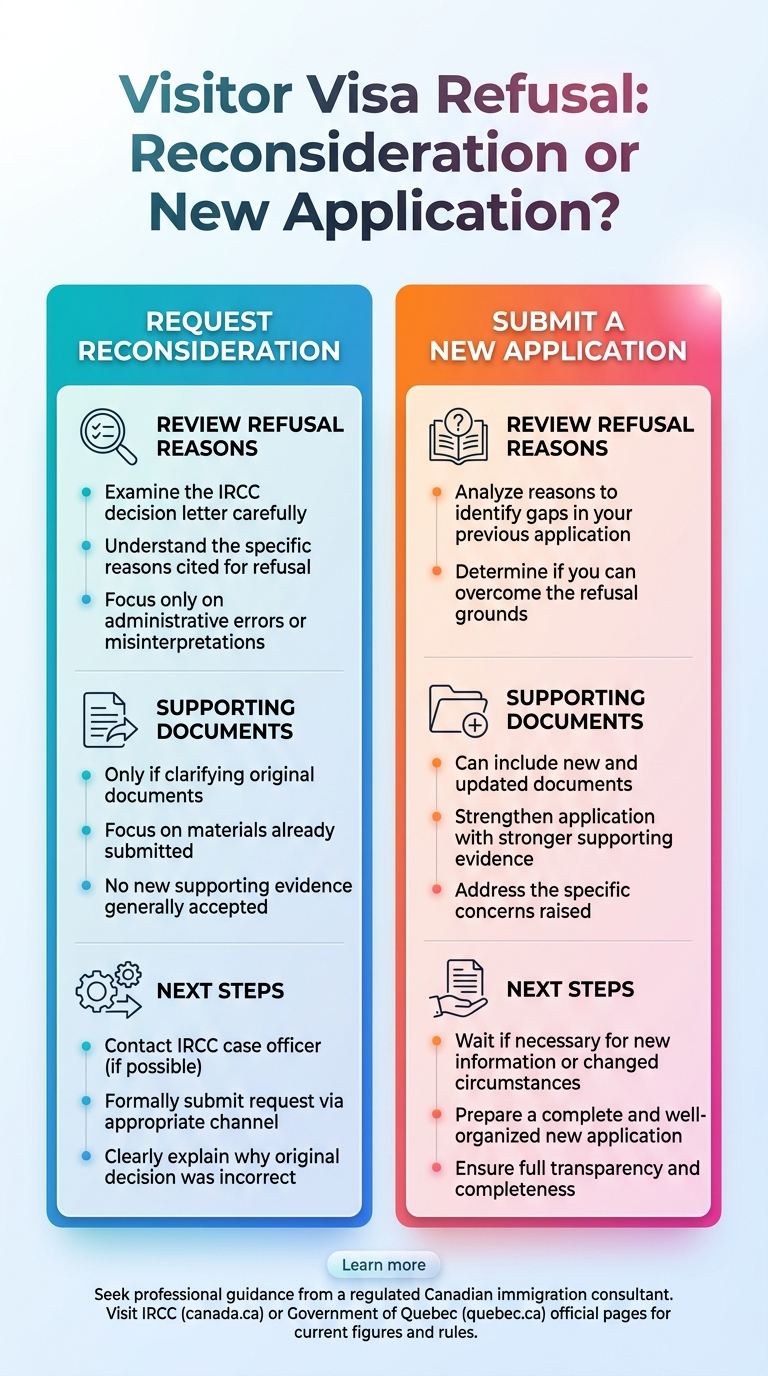
Begin by separating a possible error in assessing the application you already submitted from a concern that calls for better or additional evidence. A reconsideration request asks IRCC to revisit its decision based on an issue with the existing record, while a new application lets you present a more complete response to the refusal concerns.
If an important document appears to have been overlooked or a material fact appears to have been misunderstood, a focused reconsideration request may fit. If the file did not fully explain your travel plans, finances, or reasons to leave Canada at the end of your stay, a new application may give you a better way to address those gaps.
Disagreeing with the officer’s assessment does not, by itself, show a factual, procedural, or legal error. Choose your next step based on what the refusal says, what the original record contains, and what you can support with documents.
- Possible assessment or record error: Identify the exact document or fact and explain its connection to the refusal reason.
- Missing or weak evidence: Prepare a new application that answers the concern with clear, relevant support.
- Possible legal issue: Check promptly whether a formal court process needs attention as well.
Did you know?
54% of visitor visa applications were refused in 2024, compared with 38% in 2023.
Source: IRCC, Migration integrity, committee appearance material (June 9, 2025)
Read the refusal letter alongside the officer’s notes
Read every reason in the refusal letter and turn it into a list of concerns. Common issues include the purpose of travel, available funds, family or economic ties outside Canada, and whether the officer was satisfied that you would leave when your authorized stay ended.
Then compare the letter with the officer’s notes and with the documents you actually submitted. Since July 29, 2025, IRCC includes the officer decision note with most visitor visa refusals. The letter gives you the stated refusal reasons; the note may provide more detail about the officer’s reasoning, while the original application shows what information was available to assess.
If a note accompanied your decision, review it alongside the letter. If it is not available, follow IRCC’s current instructions for accessing records through the Access to Information and Privacy process, including any applicable eligibility and consent requirements. Our guide on reading the officer’s decision note explains the method in detail.
When the letter is brief or unclear, the notes may help explain which part of your file raised concern. Record each apparent mismatch as a specific point, tied to a document in the original application, rather than making a general claim that the officer missed the whole case.
- Make a simple chronology of the application and decision.
- List the relevant document names and where each appeared in the original file.
- Connect each document to the particular refusal reason it addressed.
A concise chronology and document index make it easier to show where evidence appeared and why it matters. They also help you distinguish a document that was genuinely in the file from information you would need to add in a new application.

When a reconsideration request may fit
A reconsideration request is strongest when it identifies a concrete, record-based concern. That could include a relevant submitted document that appears not to have been considered, a material fact described inaccurately, or a procedural concern that affected how the decision was made.
For each point, explain what the original record shows, identify where the supporting document appeared, and connect the issue to the reason for refusal. Keep the request factual and focused; a disagreement with how the officer weighed the evidence is not, on its own, proof of an error.
Our refusal analysis reviews the refusal letter and officer’s notes, identifies the reason relied on, advises whether a new application makes sense and what it should contain, and rebuilds evidence on the point that caused the refusal. This type of review can help you assess the record and choose a route before preparing a submission.
A reconsideration request is informal and discretionary. IRCC does not have to reopen the decision or respond, so do not treat the request as a substitute for a new application when your case needs new evidence.
If IRCC agrees to reconsider, it may reopen or reassess the application rather than issue a visa automatically. It may review the original record, request further information, or make a fresh decision. The outcome can still be a refusal; if the decision changes, follow any instructions IRCC provides about the application’s next steps.
Keep supporting material focused on the original file. If you rely on an upload confirmation, translation, or document reference to show where evidence appeared, make it easy for the decision-maker to locate the relevant item and understand its importance.
How to prepare and send a request
Reconsideration is an informal request, not a new application. Use the IRCC web form or the contact method stated in the decision correspondence or current visa-office instructions, and ask that the request be sent to the office that made the decision. Check the current instructions before sending, as the appropriate channel can vary.
- Identify yourself and the application using the details in your decision correspondence, including your application number and UCI if available.
- State the specific error you believe occurred and connect it to a refusal reason.
- Point to the exact document or passage in the original file, and explain briefly why it matters.
- Attach focused supporting material, such as a document reference or upload confirmation, and clearly ask IRCC to reconsider the decision.
When a new application can address the concern
According to IRCC, you can reapply at any time unless your decision letter says otherwise. A new temporary resident visa application can respond to weaknesses in the earlier file by addressing every refusal reason directly. Explain what has changed since the previous application, provide evidence that supports the explanation, and make sure the forms, invitation, itinerary, financial documents, and travel history tell a consistent story.
- Purpose of travel: Provide a credible itinerary, explain why you plan to visit, identify where you will stay, and show how your activities fit the visit.
- Funds: Show how the trip will be paid for with documents that fit your circumstances. If a host or other person will provide support, explain their role and include relevant evidence of that support.
- Ties and intent to leave: Document ongoing work, study, family responsibilities, or other commitments outside Canada. Explain how those obligations relate to the proposed trip and your plans after it.
- Changes since the refusal: Identify meaningful changes and support them with documents, rather than relying on a different cover letter for an otherwise unchanged file.
For a Quebec visit, set out the Quebec portion of the itinerary and describe host arrangements where relevant. The visitor visa decision is made federally by IRCC, so the application still needs to address the federal officer’s concerns about the visit and departure.
Our visitor visa application assistance checks whether a visitor visa, eTA, or super visa is needed and helps build a consistent file covering travel purpose, ties to the applicant’s country, and financial proof. Our guide to visitor visa documents covers each piece.
For current eligibility rules, document instructions, and official application guidance, consult IRCC’s visitor visa information after you apply. Requirements and instructions can change, so use the current official pages when preparing a new file.

Protect other options while deciding
Judicial review is a formal Federal Court process that examines whether the decision was legally reasonable and fair. It is not simply another chance to submit a stronger visitor visa application or ask the Court to reassess all the evidence from scratch.
The filing period for seeking leave is short: 15 days if the matter arose in Canada and 60 days if it arose outside Canada, from when the decision is communicated or otherwise becomes known. A reconsideration request does not pause or extend that period, so check the applicable Federal Court deadline immediately and get case-specific legal advice. Representation before the Federal Court is reserved to lawyers.
In some situations, a person may pursue a new application and a reconsideration request in parallel. Give each route a clear purpose, keep all statements accurate, and check that the information in both submissions remains consistent.
Rules and procedural requirements can change. Do not wait for an informal reconsideration response before checking whether a separate, time-sensitive option applies to your case.
Common mistakes to avoid
- Sending essentially the same application again: If the new file does not answer the refusal reasons, it may leave the same concerns unresolved. Explain what is different and document the change.
- Using reconsideration to add new evidence: New documents usually belong in a properly organized fresh application. Keep a reconsideration request tied to a specific issue in the original record.
- Writing a broad or emotional appeal: A long statement that does not identify a record-based issue can make the central point harder to assess. Use concise, factual explanations connected to documents and refusal reasons.
- Omitting the previous refusal: Answer questions about prior refusals accurately in future forms and explain relevant changes without creating contradictions between the forms and supporting documents.
- Waiting before checking other options: An informal request does not protect a separate court deadline. Review formal remedies promptly rather than waiting for a response.
- Relying on representation alone: A representative cannot assure an outcome. The decision still turns on the record, the evidence, and whether the chosen route fits the issue.
Before you submit anything, compare the final forms and documents as a single file. Names, dates, travel plans, funding explanations, and descriptions of previous applications should align across the record.

Frequently asked questions
Does a visitor visa refusal automatically prevent me from applying to Canada again?
No, a refusal does not automatically bar you from submitting another application, unless your decision letter says otherwise. The refusal history remains relevant, and any separate inadmissibility issue or instruction in the decision may affect what you can do next.
Can I travel to Canada while IRCC is considering a reconsideration request?
A reconsideration request does not itself give you permission to travel or enter Canada. You must independently hold the required travel document and meet entry requirements, and a border officer makes the admission decision.
Will a visitor visa refusal affect a separate Canadian immigration application?
A refusal does not automatically decide a separate application, which is assessed under its own requirements. However, the application may ask about past refusals, and inconsistent or incomplete answers can raise concerns about the accuracy of your information.
What should I do if my circumstances change after I submit a new visitor visa application?
Use the current IRCC process to send relevant updates and supporting documents, and identify the application they relate to. Keep copies of what you submit so you can accurately explain the updated information if IRCC asks about it later.
See also: tell us about your situation, Canada visitor visa requirements, visa refusal, refusals, procedural fairness, IRB, study permit, work permit, spousal sponsorship in Quebec.
Conclusion
For a visitor visa refusal in Canada, the choice between a reconsideration request and a new application starts with the refusal reasons and the record IRCC reviewed. Use reconsideration to raise a specific possible error in that record, use a new application to address evidence gaps, and protect any separate legal options that may apply.
We can discuss your refusal and next steps in a consultation. Book a consultation to review your situation and plan the next step.
Official sources
Official pages consulted on October 11, 2026:
- IRCC — Explaining application refusals: Officer decision note
- IRCC — Visitor visa: after you apply
- IRCC — Migration integrity, committee appearance (June 9, 2025)
More in this series
- Canada visitor visa documents: build a clear, consistent application
- Biometrics for a Canadian application: who needs them, what they cost, how long they last
- Writing an invitation letter for a Canadian visitor visa: what to include, with a template
- Super visa for your parents: a checklist for the host in Canada
- Visitor record: how to extend your stay as a visitor in Canada
About this guide
Written for Visa Canada Rouge, a Montreal immigration consultancy led by Moadh Rahmaoui, Regulated Canadian Immigration Consultant (RCIC-IRB, licence R534941, listed on the public register of the College of Immigration and Citizenship Consultants).
This guide is general information, not legal advice. Immigration requirements, fees and processing times change often: check them on the official websites (canada.ca, quebec.ca) when you apply. No outcome can be guaranteed.
Every file is different.
This guide covers the general rules. To find out what applies to you, talk to a regulated consultant.