Refusals and complex cases · Main guide
Refused by IRCC? How to read the officer's decision note before you reapply
IRCC now sends the officer's decision note with most refusals. How to read it, and how to choose between reapplying and judicial review (15 or 60 days).
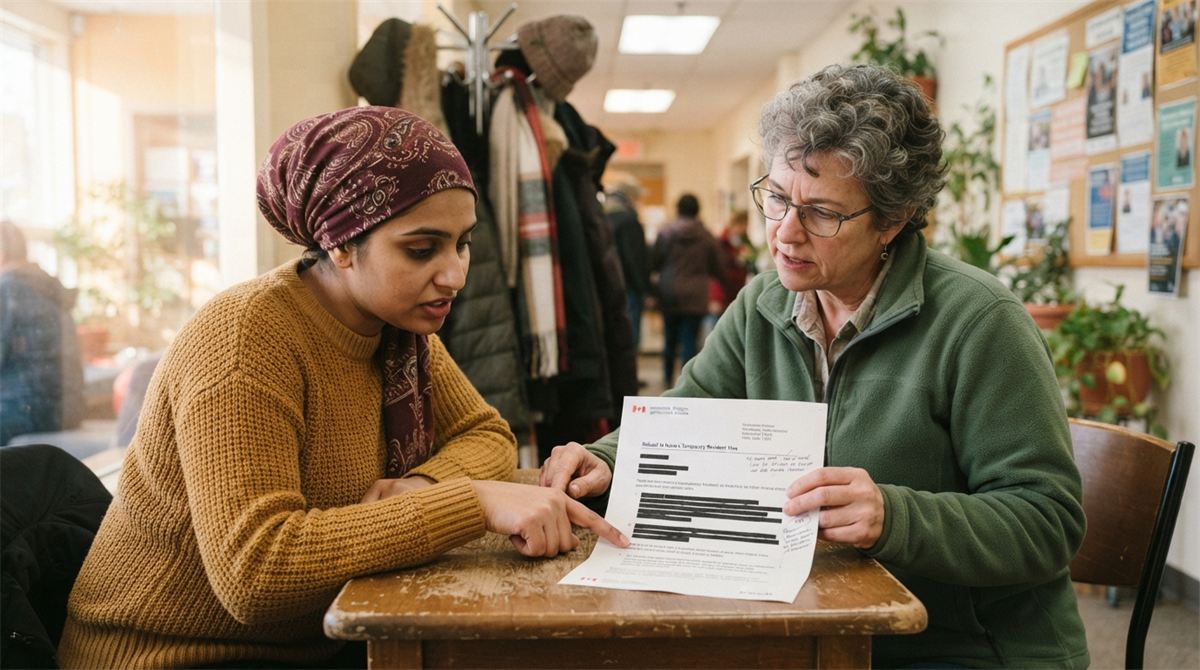
Refused by IRCC? How to read the officer’s decision notes before you reapply starts with separating what the refusal letter says from the reasoning in the notes. For years, a Canadian visa refusal came with a short letter and a few ticked boxes; to understand the real reasons, applicants had to file an access to information request and wait. That has changed: IRCC now sends the officer’s decision note with most refusal letters. Together with the exact application you submitted, those records help you decide whether to prepare a new application, ask IRCC to reconsider, or look at another route. Based on IRCC pages checked on October 17, 2026.
Key takeaways
- The letter and the notes do different things. The letter states the decision and its general reasons; the notes explain how the officer reached them.
- The notes are not the full file. If important context is missing, an access to information or privacy request can give a fuller record.
- Read a short note in context, alongside the surrounding entries, your documents and the refusal reason.
- Tell an oversight from an evidence gap by locating the exact document and comparing it with the officer’s concern.
- You can usually reapply, but a new application must answer the stated concerns.
- Check the judicial review deadline first: 15 days for a decision made in Canada, 60 days outside Canada.
What changed, and what the letter and the notes each tell you
IRCC includes an officer decision note with refusal letters for:
- most temporary resident applications since July 29, 2025: visitor visas, super visas, study and work permits and their extensions;
- most permanent resident applications since May 26, 2026, whether submitted from inside or outside Canada. Humanitarian and compassionate applications are not included.
The note is written by the officer who made the final decision and explains why the application was refused. Some passages may be removed to protect sensitive information. If you need more detail, you can still make an access to information or privacy request. See IRCC’s page on officer decision notes.
Refusal letters use general wording, such as “not satisfied you will leave Canada at the end of your stay” or “insufficient financial resources”. The note tells you what lay behind that wording in your case. Read the two together, and before drafting anything new, save the original application, forms, documents, letter, notes and correspondence in a separate folder, unchanged.

Read the notes as a timeline, not a verdict in one line
Read each entry in order and connect it to the application as IRCC saw it. A final sentence or short code can look decisive when isolated, even though an earlier entry gives the context. Separate routine processing entries from the officer’s actual assessment: does the entry point to a missing document, question the reliability of information, or explain why a criterion was not met?
Officer shorthand depends on context. Don’t build a response around an abbreviation unless its meaning is clear from the surrounding notes and matches the refusal reason. If the notes are redacted, inconsistent or incomplete, record the exact passage and what makes it unclear, rather than treating a fragment as proof that the officer ignored a document.
- List each concern in the officer’s own words.
- Link it to a requirement of the program: purpose of travel, ties, funds, eligibility, admissibility.
- Find what you sent on that point: which form, which document, which date.
- Decide what kind of problem it is: missing or weak evidence, a misunderstanding, or a possible error by the officer.
Be honest in that last step. An officer giving less weight to a document than you hoped is not the same as an officer ignoring it or getting a fact wrong.

Audit each refusal reason against the application you actually submitted
| Officer’s concern | Evidence already submitted | Oversight or different weighing? | Possible response |
|---|---|---|---|
| The purpose of the visit is unclear | Itinerary, invitation, explanation | Was a document in the file but not addressed, or did the officer find the plans unconvincing? | Show what the original evidence established; clarify or update the plan if applying again. |
| Funds don’t cover the proposed stay or study | Account records and the explanation of costs | Was a source of funds overlooked, or was the link to the costs unclear? | Connect the evidence to the costs and explain the source and use of the funds. |
| Ties or statements don’t resolve a concern | Employment, family, residence or other information filed | Does the note point to a specific inconsistency, or is it an overall assessment? | Address the specific inference with consistent evidence, not general assurances. |
Use the versions you actually submitted, not later drafts. If a document was in the file, note where and what it showed; if it was absent or did not answer the concern, record that as an evidence gap. An unfavourable conclusion does not by itself establish an error: a stronger basis is a specific discrepancy, such as a note that contradicts a document clearly present in the file.
From a note to a plan: an example
Imagine a visitor visa refused with the usual letter, and a note that reads, in substance: “Employment letter does not mention leave for the travel period. Bank statement shows a large deposit two weeks before the application, source not explained. Applicant states a 3-week visit; invitation letter mentions 6 weeks. Not satisfied the applicant will leave Canada at the end of the stay.”
| Concern in the note | What the file showed | Type of problem | What the new file needs |
|---|---|---|---|
| No leave in the employment letter | A letter confirming the job, with no dates | Evidence gap | A new letter confirming approved leave and the return date |
| Unexplained deposit | Statements only | Evidence gap | The source of the money (sale, bonus, transfer) with its proof |
| 3 weeks vs 6 weeks | Two documents that disagree | Inconsistency | One set of dates, identical everywhere, and a corrected invitation letter |
None of these is an officer’s error: the officer read what was there. That points to a new, corrected application rather than a reconsideration request or judicial review. The cover letter of the new application can take the three concerns in order and point to the document that answers each one.
Recognise how common concerns appear in the reasoning
Purpose of visit: identify what the itinerary, invitation or explanation established, then locate where the officer found the plans unconvincing; see our guide on the invitation letter. Finances: a large bundle of records is less useful than a clear account connecting the funds to the costs. Ties and credibility: find the exact inference and test whether your evidence addressed it consistently.
Québec-related applications: keep federal and Québec processes distinct. For studies, separate what relates to the CAQ from what relates to the federal study permit; an IRCC refusal does not automatically decide a separate Québec file.

Three ways forward
Apply again. According to IRCC, you can reapply at any time unless your decision letter says otherwise. It only makes sense if the new application brings new information that answers the concerns in the note. Sending the same file again is unlikely to change the outcome.
Ask IRCC to reconsider, or the Federal Court for judicial review. A reconsideration request asks IRCC to revisit its decision because of a specific error or overlooked material; disagreement with the result is not enough. Judicial review concerns the legality or fairness of a decision; it is not a general appeal. The deadlines are strict: 15 days if the decision was made in Canada, 60 days if it was made outside Canada, counted from when you were notified. The Court can set the decision aside and send it back for a new assessment; it does not grant the visa itself. IRCC advises that, in a judicial review application, you indicate that you have not received the reasons for refusal, even if you received a decision note, so the Court can request the complete reasons. Representation before the Federal Court is reserved to lawyers.
Appeal. Appeals to the Immigration and Refugee Board exist only for certain decisions, such as some sponsorship refusals; see our guide on appealing a sponsorship refusal. A visitor visa or permit refusal does not automatically come with a right of appeal.
Whatever you choose, check the judicial review deadline first, so that preparing a new application does not make you miss it.
Building a new application that answers the refusal
- Confirm you still meet the program requirements, which may have changed.
- Write a short cover letter that takes each concern from the note, in order, and points to the evidence that answers it.
- Explain each new document: what it shows and which concern it addresses.
- Explain anything that changed since your first application: job, address, plans, finances.
More documents do not automatically make a stronger file: choose evidence for its relevance. When a later form asks about previous refusals, answer accurately, with the earlier decision in front of you.
If the notes refer to suspected misrepresentation or a serious credibility finding, do not simply repeat the application: identify the exact allegation and the evidence cited, and get specialized advice; see our pages on misrepresentation and inadmissibility.
Our visa refusal page explains how we review refusals, and our complex cases page covers files with a history. You can also describe your situation or book a consultation.
Frequently asked questions
I did not receive a decision note. Why?
Not every application type is covered, and decisions made before the dates above were sent without one. You can make an access to information or privacy request to obtain the officer’s notes.
Does a refusal stop me from applying in the future?
An ordinary refusal does not, unless the letter says otherwise. You must declare it when a form asks about past refusals. A finding of misrepresentation or inadmissibility is different and has heavier consequences.
Does a refusal mean I am inadmissible?
No. A refusal does not by itself mean inadmissibility. Check whether the decision states a separate inadmissibility finding.
Can I use the notes for an application under another program?
Yes, to identify facts that need clarifying, but each program has its own criteria. Keep your answers consistent with the earlier record.
Should I reapply right away?
Only once you can answer the officer’s concerns with new information. Reapplying quickly with the same file usually produces the same result.
Does a reconsideration request pause the court deadline?
No. The 15-day or 60-day judicial review deadline keeps running while you wait for IRCC’s answer. If judicial review might be the right route, get a lawyer’s advice before the deadline passes.
Conclusion
Reading the officer’s decision notes before you reapply comes down to comparing the letter, the notes and your original application, concern by concern. Keep the record intact, distinguish an identifiable error from an evidence gap or a different weighing, check the judicial review deadline, and choose a next step that directly answers what the officer said.
Official sources
Official pages consulted on October 17, 2026:
More in this series
- Criminal inadmissibility to Canada: why the record and the circumstances matter
- How to check that an immigration consultant is authorized, and spot the fakes
- Humanitarian and compassionate applications in Canada: who can apply, and when it makes sense
- Received an IRCC procedural fairness letter? How to structure your response
- IRCC processing times explained: what the number really means
- Letter of explanation for a Canada visa application: when and how to write one
About this guide
Written for Visa Canada Rouge, a Montreal immigration consultancy led by Moadh Rahmaoui, Regulated Canadian Immigration Consultant (RCIC-IRB, licence R534941, listed on the public register of the College of Immigration and Citizenship Consultants).
This guide is general information, not legal advice. Immigration requirements, fees and processing times change often: check them on the official websites (canada.ca, quebec.ca) when you apply. No outcome can be guaranteed.
Every file is different.
This guide covers the general rules. To find out what applies to you, talk to a regulated consultant.