Family sponsorship · Main guide
Sponsoring a spouse in Quebec: how the undertaking fits the federal process
Federal approval, Quebec undertaking, then permanent residence: the steps, the 13,300 cap until June 2028, and what the three-year undertaking commits you to.
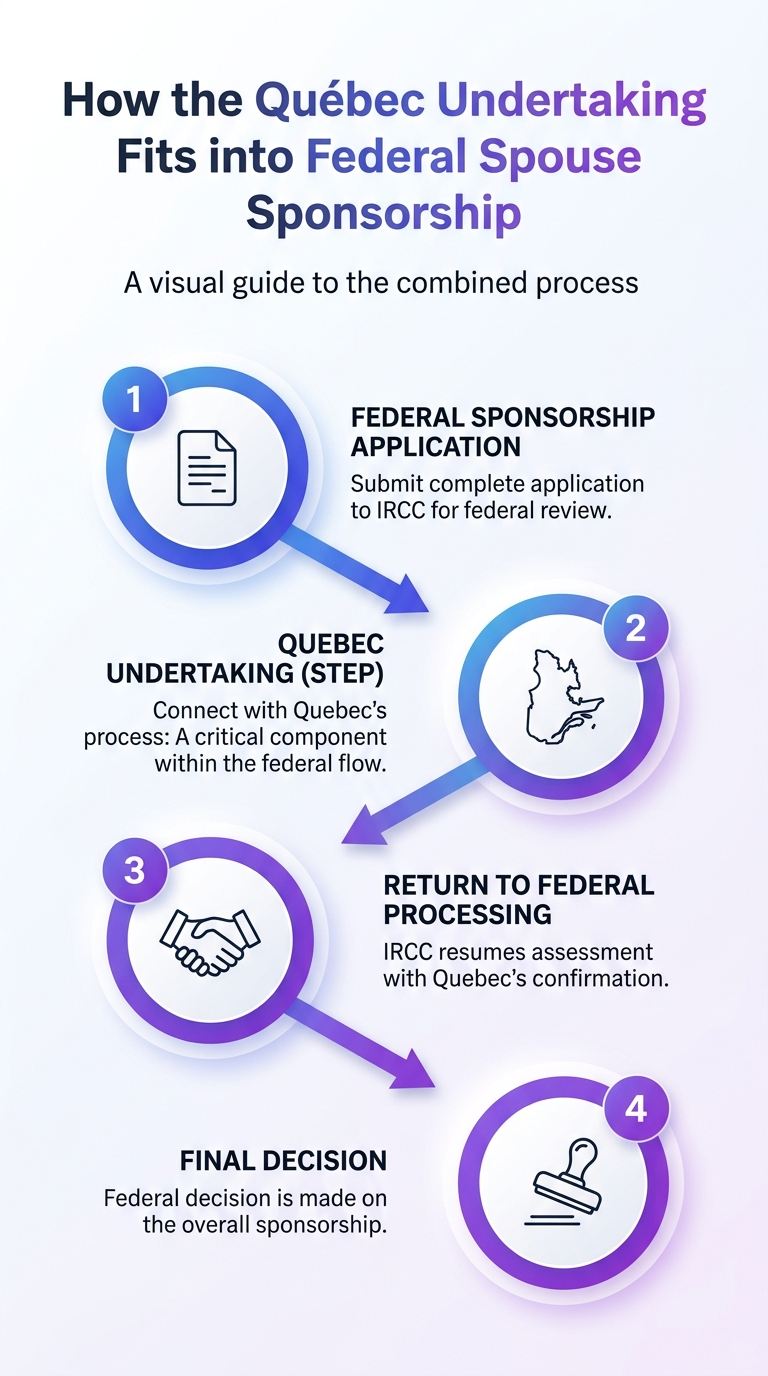
Quebec spouse sponsorship has linked federal and provincial stages: submit the sponsorship and permanent-residence package to IRCC first, then follow IRCC’s notice about filing the Quebec undertaking with MIFI. The total wait has no single fixed estimate because the stages and any intake limit are separate.

Key points to keep in mind
- Begin with the federal application to IRCC, then follow its notice about the Quebec step.
- Federal sponsor eligibility and MIFI’s undertaking decision are separate decisions.
- The sponsor completes undertaking materials; the sponsored person and dependants may have their own forms.
- Quebec limits the number of spousal undertaking applications it receives, so review current instructions before submitting.
- After Quebec’s decision, IRCC continues its permanent-residence assessment.
The federal and Quebec stages are separate parts of one process
For a spouse or partner planning to settle in Quebec, the process involves federal sponsorship and a Quebec undertaking. These are distinct parts of the case.
- Submit the federal sponsorship and permanent-residence package to IRCC and keep its correspondence.
- When IRCC confirms your eligibility and gives instructions about the Quebec step, prepare and submit the undertaking package to MIFI through the channel and within any deadline stated in the instructions.
- Respond separately to requests from each authority. After MIFI’s decision, IRCC continues the permanent-residence assessment.
IRCC handles federal sponsorship and permanent-residence assessment; MIFI handles the Quebec undertaking and selection step. A decision by one authority does not replace the decision assigned to the other.
Use IRCC’s instructions to identify when to start the Quebec step; submitting the federal package alone does not mean the MIFI package is ready to file.
We describe the coordinated federal and provincial preparation involved in spousal sponsorship in Québec, including checking sponsor and relationship eligibility, organizing relationship evidence, and preparing the applications in the required order. This kind of coordination helps keep each authority’s request connected to the correct stage.
Keep IRCC and MIFI correspondence as separate action lists. For every letter, record what is requested, the deadline, the required submission channel, and which person’s documents are needed.
Use the current IRCC family sponsorship instructions and the Government of Quebec’s family reunification guidance as your reference points. Forms, intake instructions, and program rules can change, so check the official pages again when preparing each submission.

Check sponsor and relationship eligibility before building the file
First, assess whether the sponsor meets the federal requirements that apply to their circumstances. The sponsor must be at least 18 and a Canadian citizen, a person registered under the Indian Act or a permanent resident. A permanent resident living outside Canada cannot sponsor; a citizen living abroad must show they plan to live in Canada when their partner becomes a permanent resident.
Check the sponsor’s status and Quebec residence plans against the current IRCC and MIFI eligibility conditions. Also check for past undertaking obligations, defaults, or other sponsorship bars that could affect eligibility: for example, a sponsor who was sponsored as a spouse or partner and became a permanent resident less than five years ago, or whose undertaking for a former spouse or partner is still in effect or ended less than three years ago, may not be eligible. Confirm these sponsor-specific requirements before choosing forms; they are separate from proving that the relationship fits its category.
Next, identify the relationship category correctly. A spouse, common-law partner, and conjugal partner are distinct categories under federal rules, and each has its own definition and evidence expectations.
- Spouse: Legally married to the sponsor and at least 18. Provide records that establish the legal marriage and a genuine relationship.
- Common-law partner: Living with the sponsor in a conjugal relationship for at least 12 consecutive months. Organize records that show the shared residence over that period.
- Conjugal partner: In an exclusive relationship for at least a year, living outside Canada, and unable to live together or marry for legal, immigration, social, cultural or religious reasons. Explain the relationship and those barriers.
For a common-law or conjugal-partner application, arrange relevant records clearly and connect them to the circumstances of the relationship. In every category, the relationship must be genuine and not entered into mainly to obtain status.
Keep the federal and Quebec requirements distinct: sponsorship involves both governments, and the Quebec undertaking is a separate provincial step. Check current guidance before deciding which category and documents apply.
Understand what the undertaking commits the sponsor to
The Quebec undertaking is a formal commitment connected to sponsorship in Quebec. It is separate from assessing whether the relationship meets the applicable requirements.
Federal approval to sponsor does not complete the Quebec undertaking requirements. The sponsor must still submit the provincial materials requested by MIFI and meet the rules that apply to that undertaking.
In Quebec, the undertaking for a spouse, common-law partner or conjugal partner lasts 3 years, starting when the person obtains permanent residence. During that period, the sponsor commits to providing for the person’s basic needs. The undertaking does not end with a separation, a divorce, citizenship or a move to another province, and if the sponsored person receives social assistance during the undertaking, the sponsor may have to repay it. For accompanying dependent children, the undertaking lasts longer and depends on their age.
A financial capacity assessment is not required when you sponsor only a spouse or partner; it can be required in some situations, for example when a dependent child of the sponsored person has a child of their own. Consider the undertaking carefully before signing, and make sure you understand the current conditions that apply to your case. Our article on the obligations of a Quebec sponsorship undertaking goes into detail.
Match each form and supporting document to the right person
Build a party-by-party checklist before completing forms. The sponsor handles the sponsorship and undertaking materials, the sponsored person completes the applicable permanent-residence and Quebec permanent-selection materials, and each dependant may have separate forms or supporting records.
A consultation can help families organize those roles and prepare relationship evidence alongside the federal and Quebec applications. Our spousal sponsorship in Québec consultation focuses on eligibility, evidence, and putting the two applications in the right order.
Keep identity and civil-status information consistent across both files. If names, dates, or family details differ between records, explain the difference clearly and provide documents that support the explanation instead of leaving the authorities to reconcile conflicting information.
For relationship evidence, choose a coherent range of records that shows the relationship’s history and everyday reality. Depending on the case, useful evidence may include:
- Records of shared residence and household arrangements.
- Communications and visits that show the relationship over time.
- Financial arrangements or shared responsibilities.
- Evidence that family and friends know about the relationship.
Arrange records chronologically and add a brief explanation for unusual gaps or changes in living arrangements. A clear index can help the officer understand what each document demonstrates without having to infer the timeline.
For dependent children, check each child’s requirements individually. Accompanying dependent children must be included, and forms, identity records, consent documents, and evidence can depend on the child’s circumstances, so a parent’s completed forms do not automatically satisfy a child’s part of the file.
Use the current IRCC and Quebec checklists to confirm which form versions, signatures, translations, supporting documents, and payment method apply. The required package depends on the case, and official instructions can change.

Submit the Quebec undertaking at the right point and check intake rules
Treat the Quebec undertaking as a distinct step in the process, and check the current instructions that apply to your case before filing.
Did you know?
From July 2, 2026 to June 30, 2028, Quebec will receive at most 13,300 undertaking applications for spouses, common-law partners and conjugal partners.
Applications received once that maximum is reached are returned without being processed; some situations are exempt, including sponsoring a dependent child under 22. Source: Government of Québec, sponsoring a family member (French)
Because of that limit, the Quebec package should be ready as soon as IRCC’s letter arrives. Review the provincial package as one coordinated submission. Confirm that it contains the right forms for each relevant person, all required signatures and consent, supporting records, and payment made using the method in the current instructions.
Use the current MIFI checklist to identify the sponsor’s undertaking form and the sponsored person’s Quebec selection application, including any forms required for dependants. Check which identity and civil-status records, proof of the sponsor’s status or residence, relationship evidence, and dependant documents apply to your case. Include required translations, signatures and consent, and pay the fee using the instructed method. The MIFI checklist controls its package; an IRCC document set does not automatically cover it.
Keep a complete copy of the package and evidence that it was delivered. Monitor the channels used by both IRCC and MIFI, since a request or update from one authority does not replace a separate action requested by the other.
If MIFI returns a file as incomplete, use the return notice to identify each missing item or correction. Rebuild the package under the current instructions, recheck signatures, payment and submission channel, and follow the stated resubmission process. A returned file costs time, and potentially a place under the limit.
Common mistakes that can disrupt the handoff
- Treating the undertaking as the whole application: Keep the federal sponsorship and permanent-residence process active alongside the Quebec stage.
- Filing the Quebec package too early: Use IRCC’s notice and MIFI’s current intake instructions to confirm when and how to submit.
- Assuming a Quebec decision ends the case: Continue to monitor IRCC and respond to its requests until it completes the permanent-residence assessment.
- Using old forms or intake instructions: Check the current Quebec rules immediately before filing, especially while the intake limit applies.
- Overlooking a person-specific requirement: Review signatures, payment instructions, dependant forms, and consent documents against the checklist for every applicant.
- Missing a separate request: Record IRCC and MIFI requests independently, reply through the channel specified, and report relevant changes to the authority handling the affected part of the file.
- Signing the undertaking without understanding it: It survives a separation.
When the sequence or a document requirement is unclear, a file review can help identify what needs attention before submission. We can discuss your circumstances through our consultation service.
See also: spousal sponsorship in Quebec, who can sponsor a spouse in Quebec, tell us about your situation, work permit, visitor visa, complex cases.
Conclusion
Quebec spouse sponsorship comes down to following the handoff in order. IRCC assesses federal sponsor eligibility and permanent residence, MIFI reviews the Quebec undertaking and selection step, and IRCC resumes its assessment after Quebec’s decision.
Prepare forms and evidence for the correct person, follow each authority’s instructions separately, and verify current intake rules before filing. That approach helps families avoid preventable returns and keep the federal and Quebec parts of the application coordinated.
Frequently asked questions
How long does Quebec spouse sponsorship take?
There is no single combined estimate: IRCC’s processing-time tool covers the relevant federal application, not the separate Quebec wait. Check that tool and MIFI’s current processing information separately. The Quebec stage follows the federal instructions, and the intake limit can affect when its package may be filed, so confirm the rules for your category before estimating the total.
Can my spouse apply for an open work permit while sponsorship is in process?
In some circumstances, a spouse in Canada may qualify for an open work permit while a sponsorship application is underway. Filing a sponsorship application does not itself grant work authorization, so check IRCC’s current open work permit criteria for the person’s situation.
What should we do if our family circumstances change after we submit?
Report a change, such as a new address, a change in the relationship, or a change affecting a dependant, to the authority handling the affected part of the file. Follow that authority’s current procedure and include the application details it needs to identify the case.
Can my spouse live outside Canada during the sponsorship process?
An application may follow an overseas or in-Canada route depending on where the sponsored person lives and which federal class applies. Living abroad does not by itself answer whether the sponsor meets Quebec’s requirements, so assess the sponsor’s Quebec residence plans and the applicable federal route together.
For guidance on your circumstances, book a consultation with our team.
Official sources
Official pages consulted on October 11, 2026:
- IRCC — Sponsor your spouse, partner or children
- IRCC — Who you can sponsor
- Québec — Sponsor a family member (French)
More in this series
About this guide
Written for Visa Canada Rouge, a Montreal immigration consultancy led by Moadh Rahmaoui, Regulated Canadian Immigration Consultant (RCIC-IRB, licence R534941, listed on the public register of the College of Immigration and Citizenship Consultants).
This guide is general information, not legal advice. Immigration requirements, fees and processing times change often: check them on the official websites (canada.ca, quebec.ca) when you apply. No outcome can be guaranteed.
Every file is different.
This guide covers the general rules. To find out what applies to you, talk to a regulated consultant.