
The landscape of Canadian immigration continues to reward those who understand its nuances, and nowhere is this more evident than in Express Entry category-based selection French proficiency draws: in a single February 2026 round, IRCC issued 8,500 Invitations to Apply with a minimum CRS cut-off of just 400, a figure that would be unthinkable in a general, all-program draw. Navigating this particular selection pathway is not simple, but for candidates who invest in their French language skills and understand precisely how the category operates, it can represent one of the most strategic routes to permanent residency in Canada today.
Key Takeaways
| Question | Answer |
|---|---|
| What is Express Entry category-based selection French proficiency? | It is a dedicated ministerial draw within the Express Entry system that invites candidates who demonstrate strong French language skills, regardless of whether their overall CRS score would qualify in a general draw. |
| What French language score do I need? | You generally need to achieve a minimum CLB 7 in all four abilities (reading, writing, listening, speaking) on a designated French language test such as the TEF Canada or TCF Canada. |
| Is the French proficiency category still active in 2026? | Yes. IRCC has confirmed the French-language proficiency category as an explicit, ongoing category-based selection stream for 2026, with multiple draws already conducted this year. |
| What CRS score do I need for the French proficiency category draw? | Cut-offs vary by draw. In 2026, they have ranged from approximately 400 to 409, which is considerably lower than most all-program general draws. |
| Does French proficiency add points to my CRS score directly? | Yes. Strong French scores can add up to 50 additional CRS points through the official French-language skills factor, giving bilingual candidates a meaningful advantage in all draw types. |
| Where can I get professional guidance on the French proficiency pathway? | At Visa Canada Rouge, our team offers tailored consultation services designed around the unique facts of each client’s case. You can schedule a consultation to discuss your French proficiency profile in detail. |
| Who is best suited for the French proficiency category? | Candidates who are proficient in French, hold a valid Express Entry profile under FSW, CEC, or FST, and have a CRS score that would not be competitive in a general draw stand to benefit the most. |
Understanding Express Entry Category-Based Selection French Proficiency
Since IRCC introduced category-based selection in 2023, the Express Entry category-based selection French proficiency pathway has become one of the most consequential strategic levers available to prospective permanent residents. The rationale behind this selection mechanism is rooted in Canada’s commitment to strengthening French-speaking communities outside of Quebec, a national policy objective that is not merely symbolic but drives real invitation activity every year.
What makes this category distinct from a general Express Entry draw is the selection criterion: rather than simply ranking all eligible profiles from highest to lowest CRS and issuing invitations, IRCC uses the French-language proficiency category to pull forward candidates who meet a specific linguistic threshold. In practice, this means that a candidate with a CRS score of 405 could receive an Invitation to Apply through a French-language category draw that would never have reached them in a general round where cut-offs routinely exceed 480 or more.
It is important to understand, however, that this pathway carries its own eligibility conditions, its own strategic calculus, and its own risks. What you think is a straightforward question about whether your French score qualifies you is, in our experience, almost always more nuanced than it appears, and the answer depends on the specific facts of your profile.
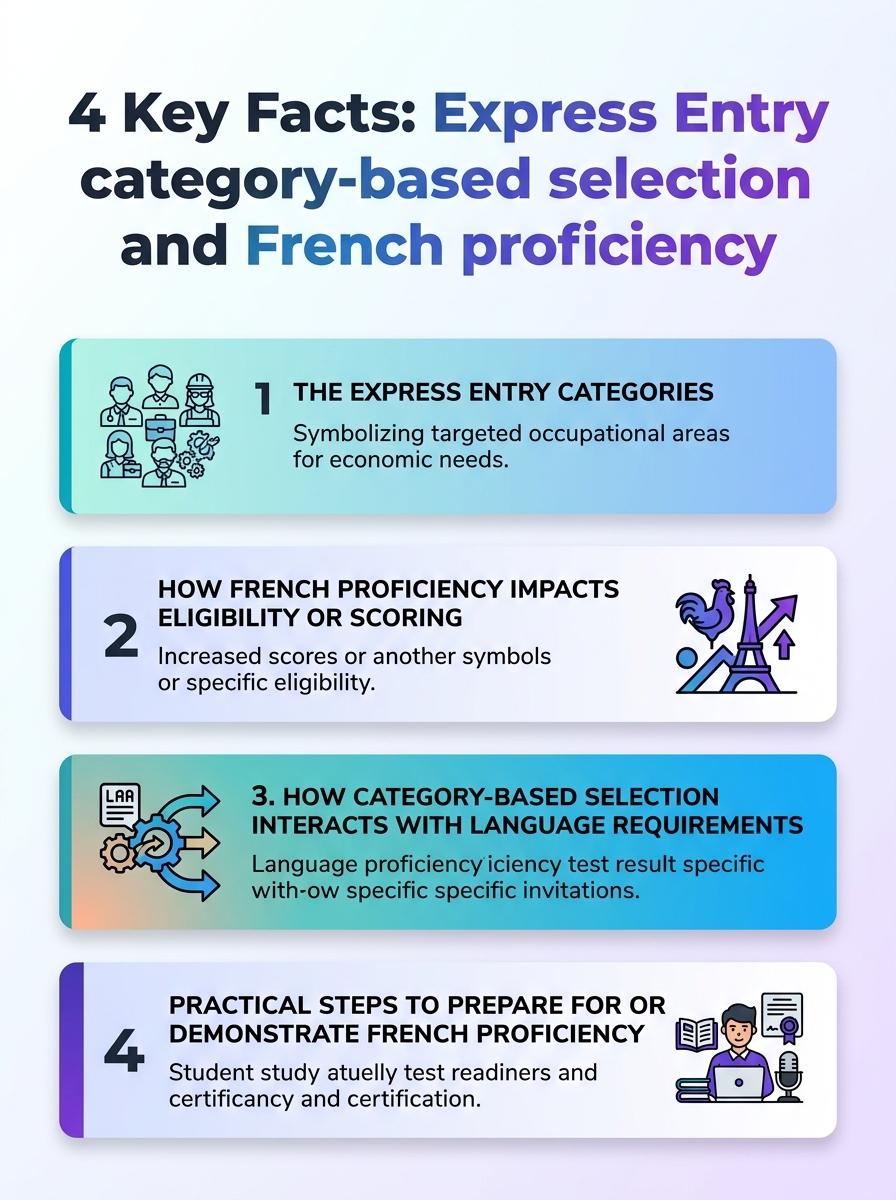
Four essential facts about Express Entry’s category-based selection and French proficiency. Learn how language skills influence eligibility and ranking.
Who Qualifies for the French Proficiency Category-Based Selection?
Eligibility for Express Entry category-based selection French proficiency draws rests on several interconnected requirements. Meeting all of them simultaneously is what separates a competitive candidate from one who simply believes they qualify.
First, you must hold an active Express Entry profile under one of the three managed programs: the Federal Skilled Worker Program (FSWP), the Canadian Experience Class (CEC), or the Federal Skilled Trades Program (FSTP). The French-language category is not a pathway unto itself; it is a selection mechanism applied within the existing Express Entry pool.
Second, your French language test results must meet the minimum threshold. IRCC requires candidates to demonstrate at least Canadian Language Benchmark (CLB) 7 across all four language skills: reading, writing, listening, and speaking. This is a meaningful benchmark, not a low bar, and candidates who approach it casually often find themselves falling short in one skill or another.
Third, your profile must be in the pool at the time of the draw. An expired or incomplete profile cannot receive an invitation, regardless of your French proficiency level.
- Hold an active profile in the Express Entry pool under FSW, CEC, or FST
- Achieve a minimum of CLB 7 in all four French language skills
- Submit results from an approved test: TEF Canada or TCF Canada
- Meet the program-specific eligibility criteria (work experience, education, etc.)
- Have a valid profile at the time IRCC conducts a French-language category draw
“Every immigration journey is unique, and at Visa Canada Rouge, we understand this intricately. The French proficiency category is an opportunity, but it must be approached with a clear-eyed assessment of your full profile.”
How French Proficiency Affects Your CRS Score Within Category-Based Selection
One of the most frequently misunderstood aspects of the Express Entry category-based selection French proficiency pathway is the relationship between your language scores and your overall Comprehensive Ranking System (CRS) score. These two things interact in ways that significantly affect your strategy.
Within the CRS, French language ability can contribute additional points in two distinct ways. The first is through the core language factor: if French is your first official language, your scores contribute directly to the core human capital factors. The second is through the additional points available for French language skills, which can add up to 50 CRS points for candidates who demonstrate strong French ability alongside English.
Importantly, even in a French-language category draw, IRCC still ranks eligible candidates by CRS score. The category designation determines who is eligible to be considered in that specific draw; the CRS score determines the order in which they receive invitations. This is why understanding your CRS optimization strategy remains critical, even if you are targeting the French-language category specifically.
The Language Tests Accepted for Express Entry French Proficiency Category-Based Selection
Candidates pursuing the Express Entry category-based selection French proficiency pathway must submit results from one of two designated French-language tests. IRCC does not accept informal assessments, institutional certificates, or other language qualifications as substitutes for these standardized examinations.
The two accepted tests are:
- TEF Canada (Test d’évaluation de français pour le Canada): Administered by the Chambre de commerce et d’industrie Paris Île-de-France, the TEF Canada is widely available internationally and assesses all four language competencies. The corresponding CLB 7 benchmarks for TEF Canada are specific numerical score ranges published by IRCC.
- TCF Canada (Test de connaissance du français pour le Canada): Administered by France Éducation International, the TCF Canada is also accepted for immigration purposes and similarly assesses listening, reading, speaking, and writing.
A critical planning consideration: language test results carry an expiry date. For Express Entry purposes, your language test results are valid for two years from the date of the test. If your results expire while your profile is in the pool, you will need to retest and update your profile to maintain eligibility for category-based selection draws.
This temporal constraint adds a layer of planning complexity that many candidates underestimate. We have accompanied clients through the process of navigating the Express Entry pathway from initial profile creation to invitation, and the question of test validity timelines is one of the most common points of confusion we encounter in consultations.
CRS Cut-Offs and Invitation Volumes in French Category-Based Selection Draws
For candidates assessing whether the Express Entry category-based selection French proficiency pathway is realistic for them, the data from recent draws provides essential context. The pattern that has emerged in 2026 is both encouraging and instructive.
French-language proficiency draws in 2026 have consistently operated with cut-offs well below those of general all-program draws. The February 2026 draw (round 394) issued 8,500 invitations with a CRS cut-off of 400. The May 28, 2026 draw issued 4,500 invitations with a cut-off of 409 (Version 2). These figures confirm that the French proficiency category is not a marginal or occasional draw mechanism; it is a high-volume pathway that IRCC uses purposefully to advance its francophone immigration objectives.
That said, it is equally important not to assume a fixed outcome. CIC News has reported that invitation volumes and cut-off scores can shift meaningfully between consecutive French-language draws, reflecting IRCC’s ministerial discretion in managing the pathway. What was true in one round may not be true in the next, and strategy must account for this variability rather than being built on static assumptions.
The comparative context is also worth noting. According to IRCC data, the distribution of eligible Express Entry profiles by category in 2024 was approximately 19% for STEM occupations, 9% for French-language proficiency, 10% for healthcare, 3% for transport, 4% for trades, and about 1% for agriculture. The French category represents a significant but by no means universal pathway: eligibility is selective, and that selectivity is part of what keeps the cut-offs attractive for those who do qualify.
Best Strategies to Maximize Your Chances in the French Proficiency Category
Understanding the mechanics of Express Entry category-based selection French proficiency is one thing; translating that understanding into a concrete, personalized strategy is another. Below, we outline the most effective approaches our team works through with clients.
1. Prioritize your French test preparation seriously. CLB 7 is the entry point, not the ideal target. Candidates who achieve CLB 9 or CLB 10 in all competencies not only qualify for the category but also accumulate additional CRS points that improve their ranking within the eligible pool. The difference between CLB 7 and CLB 9 can be 20 to 30 CRS points, which is significant at draw time.
2. Optimize all other CRS factors in parallel. The French proficiency category lowers the bar for eligibility, but it does not eliminate the CRS ranking. Securing a valid job offer, improving your English language results, obtaining a Canadian educational credential assessment, or gaining additional Canadian work experience can all contribute to a stronger overall profile.
3. Maintain an active, updated profile. An expired language test, an outdated work experience entry, or a missing document can render your profile ineligible at the moment a draw occurs. Profile maintenance is a continuous responsibility, not a one-time task.
4. Monitor draw timing without obsessing over it. Category-based selection draws are scheduled at IRCC’s discretion. While candidates understandably monitor IRCC announcements closely, strategy should be built around strengthening your profile, not around predicting draw dates that may shift without warning.
5. Seek a structured, case-specific assessment. As we consistently advise our clients, what appears to be a simple eligibility question is almost always shaped by the particular facts of your case. A professional profile evaluation can surface issues and opportunities that are not visible from a general overview of the rules.
The Role of Provincial Nominee Programs Alongside the French Proficiency Category
Candidates whose French proficiency qualifies them for category-based selection should also be aware that several Canadian provinces operate streams specifically designed to attract French-speaking candidates. These Provincial Nominee Program (PNP) streams can work alongside your Express Entry profile in two distinct ways.
First, a provincial nomination adds 600 CRS points to your profile, effectively guaranteeing an invitation in the next general draw. For a French-speaking candidate with a moderate CRS who is also eligible for the French-language category, the interplay between provincial nomination options and category-based selection timing becomes a genuine strategic decision rather than a default choice.
Second, some provinces that prioritize francophone immigration outside Quebec actively recruit candidates from the Express Entry pool whose profiles demonstrate French proficiency. This means that your French test scores can open doors in both the federal category-based draw system and the provincial nomination system simultaneously.
We are careful to note here, as always, that the right approach depends entirely on the specific facts of your case. The complexity of coordinating a provincial nomination pathway with category-based selection timing is precisely the kind of nuanced challenge that benefits from professional guidance.
How Visa Canada Rouge Supports Your French Proficiency Express Entry Journey
As a firm founded by immigrants for immigrants, our clients are our absolute priority, and we make every effort to ensure the success of each case. The Express Entry category-based selection French proficiency pathway is one where we see a consistent pattern: candidates arrive with a general understanding of the opportunity but with gaps in their grasp of the mechanics that matter most at decision time.
Our team of experienced consultants works closely with clients to navigate every stage of the immigration process. For candidates targeting the French-language proficiency category specifically, our support typically encompasses the following dimensions:
- Profile eligibility assessment: We review your profile against current IRCC requirements for the French-language proficiency category, including test score thresholds, language test validity, and program-specific criteria.
- CRS optimization strategy: We identify which factors in your profile have the highest potential for improvement and advise on the sequence and timing of steps most likely to raise your CRS competitively.
- Documentation review: We ensure your supporting documents are complete, accurate, and formatted to IRCC’s standards, reducing the risk of procedural delays or refusals.
- Ongoing monitoring and updating: We work with you to keep your profile current and to respond appropriately as draw patterns evolve through 2026.
We do not look only at the simplest cases. We also take on the most complex ones, providing our clients with adequate instruction and support throughout. Our 95% success rate across our consulting history reflects not a filter that excludes difficult files, but a commitment to thorough, case-specific preparation that increases the likelihood of a favorable outcome in every profile we work with.
We are proud to contribute to Canada’s global mobility, diversity, and multiculturalism. Every French-proficiency profile we help guide through the Express Entry system represents another future Canadian who will strengthen francophone communities across the country.
If you are ready to understand where your specific profile stands relative to the French-language category, we invite you to book a consultation with our team. We want to emphasize that we cannot provide information or advice outside the context of a planned consultation appointment, as the details of your case are what determine the right path forward.
Conclusion
The Express Entry category-based selection French proficiency pathway represents one of the most accessible and strategically valuable routes to Canadian permanent residency available in 2026. With CRS cut-offs substantially lower than those seen in general draws, draw sizes regularly reaching into the thousands, and the category confirmed as an ongoing ministerial priority, candidates who invest seriously in their French language proficiency have a genuine and documented advantage in the invitation process.
The pathway is not, however, without its complexities. Eligibility thresholds, test validity timelines, draw variability, and the interplay between CRS optimization and category-based selection timing all require careful attention. What appears to be a straightforward question about French test scores is, in practice, embedded within a broader profile strategy that must be built on the specific facts of your case.
At Visa Canada Rouge, we are committed to ensuring that every client we work with approaches the Express Entry category-based selection French proficiency pathway with clarity, preparation, and a strategy tailored precisely to their circumstances. Our role is not simply to fill out forms; it is to be a trusted partner in a journey that has the potential to reshape your future and contribute to the multicultural fabric of Canada.
We encourage you to take the first step: visit our About Us page to learn more about our team and our approach, and reach out to schedule a consultation when you are ready to move forward with purpose and confidence.
Frequently Asked Questions
What is the minimum CRS score needed for an Express Entry French proficiency category draw in 2026?
In 2026, French-language proficiency category draws have had CRS cut-offs ranging from approximately 400 to 409, which is significantly lower than general all-program draw cut-offs. However, these figures vary by draw, and IRCC does not pre-announce a guaranteed minimum, so building the strongest possible profile remains the most reliable strategy.
How do I know if I qualify for Express Entry category-based selection French proficiency?
To qualify, you must hold an active Express Entry profile under FSW, CEC, or FST, and demonstrate a minimum CLB 7 in all four French language skills on either the TEF Canada or TCF Canada test. Because eligibility depends on the interaction of multiple factors specific to your profile, a professional assessment is the most reliable way to confirm your status.
Is French proficiency category-based selection better than applying through a general Express Entry draw?
For candidates whose CRS scores would not reach the cut-off in a general draw, the French-language proficiency category is often the more accessible route, given its lower CRS thresholds. The right answer depends on your individual score, your French test results, and the current draw environment, which is why a tailored consultation is more useful than a general comparison.
Does improving my French score increase my CRS points even outside category draws?
Yes. Strong French language scores contribute up to 50 additional CRS points through the French-language skills factor within the CRS scoring grid. This means that improving your French proficiency strengthens your profile for general draws, category-based selection draws, and provincial nomination streams simultaneously.
How often does IRCC hold Express Entry French-language proficiency category draws in 2026?
IRCC conducts French-language proficiency category draws at its own discretion and does not publish a fixed schedule. In 2026, multiple French-language draws have already occurred, including large rounds in February and May. Candidates should monitor IRCC announcements regularly and maintain an active, fully updated profile to be eligible whenever a draw takes place.
Can I use my French skills for both Express Entry and a Provincial Nominee Program?
Yes. French proficiency can qualify you for the federal category-based selection pathway and, simultaneously, make you eligible for francophone streams within several Provincial Nominee Programs. These pathways can be pursued in parallel or in sequence depending on your profile, timelines, and provincial targets, and the optimal approach requires a case-by-case assessment.
Is it worth hiring a consultant for Express Entry French proficiency category applications in 2026?
Given the complexity of maintaining profile eligibility, optimizing CRS scores, managing test validity windows, and navigating shifting draw patterns, professional guidance significantly reduces the risk of costly errors. Firms with a demonstrated record in Express Entry category-based selection French proficiency cases, like Visa Canada Rouge with a 95% success rate, provide not only procedural support but also strategic advice that can meaningfully improve outcomes.