
Understanding Francophone Minority Communities Student Pilot eligibility is the critical first step toward building your Canadian future, and the stakes have never been higher: a staggering 66% of Francophone students from Africa were historically refused study permits before this pilot was created, a statistic that reveals exactly why this program exists and why navigating it correctly matters so profoundly. At Visa Canada Rouge, a firm founded by immigrants for immigrants, we are here to guide you through every detail of this pathway with the expertise and care your dossier deserves.
Key Takeaways
What Is the Francophone Minority Communities Student Pilot?
The Francophone Minority Communities Student Pilot (FMCSP) is an initiative launched by Immigration, Refugees and Citizenship Canada (IRCC) with a clear and ambitious mandate: to strengthen the vitality of French-speaking communities outside Quebec by welcoming international students who choose to study, live, and build their lives in those communities.
Unlike traditional study permit streams, this pilot is specifically designed to lower the barriers that historically prevented Francophone students, particularly those from sub-Saharan Africa, from receiving approval. It reframes the student journey not just as an educational pursuit, but as a concrete parcours toward Canadian permanent residence.
The program targets provinces and territories outside Quebec, directing French-speaking talent toward regions where Francophone communities need reinforcement. It is part of Canada’s broader commitment to mobilité mondiale and the protection of its linguistic duality outside the province of Quebec.
Core Francophone Minority Communities Student Pilot Eligibility Criteria
Meeting Francophone Minority Communities Student Pilot eligibility requires satisfying several interconnected conditions. Each criterion carries equal weight, and a gap in any one of them can affect the outcome of your application. Our consultants stay constantly informed of every update and procedural change to ensure your dossier solide reflects the most current requirements.
Here is a structured overview of the core conditions:
- Enrollment at a designated institution located outside Quebec that participates in the FMCSP program.
- Program of study in French, where more than 50% of the coursework is delivered primarily in French.
- Demonstrated French-language proficiency at a level meeting IRCC’s minimum threshold for the pilot.
- Proof of financial resources equivalent to at least 75% of the applicable local low-income cut-off (LICO).
- Acceptance letter from the designated institution confirming enrollment in a qualifying French-language program.
- No criminal inadmissibility and compliance with all general admissibility requirements under Canadian immigration law.
- Intention to settle in the Francophone minority community associated with the designated institution.
Navigating these conditions sur mesure to your personal situation is precisely where professional guidance becomes indispensable. At Visa Canada Rouge, we identify which conditions you currently satisfy and map out the clearest route to fulfilling the remaining ones.
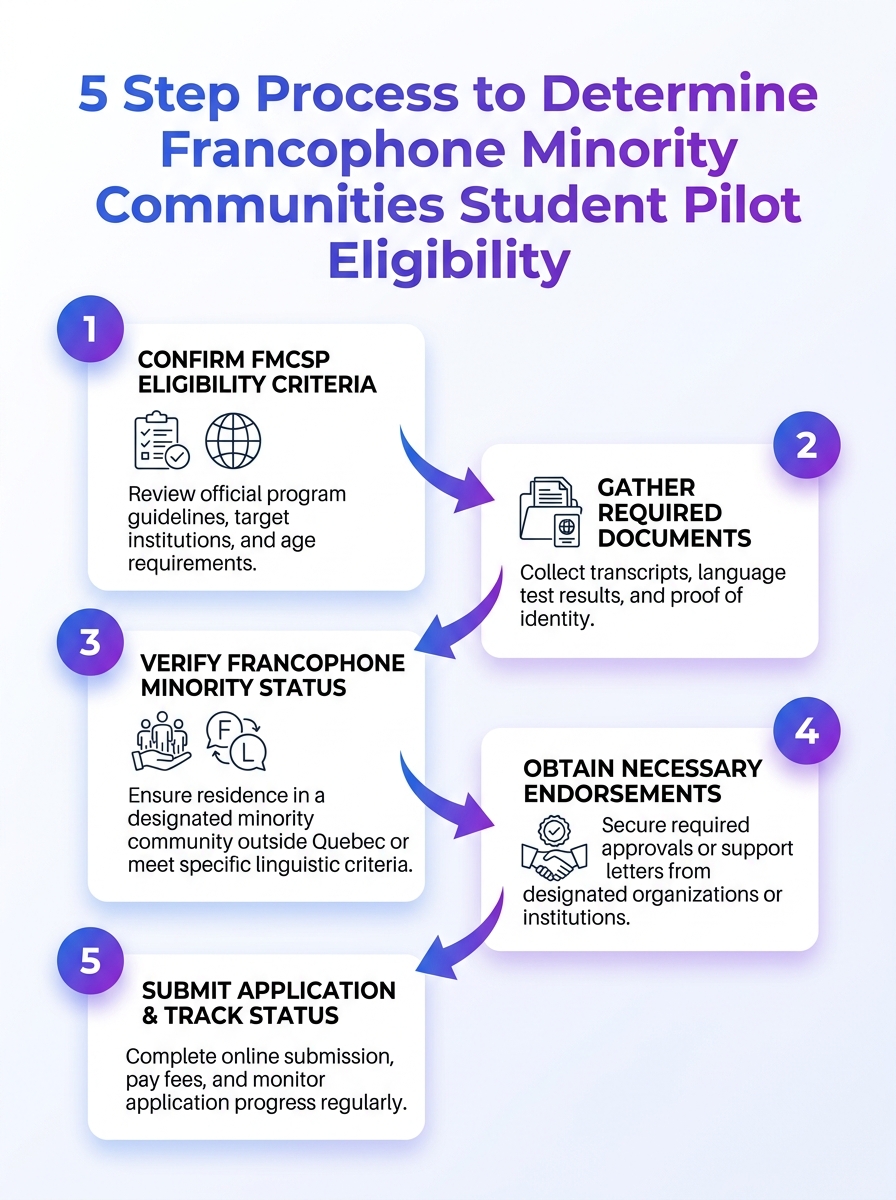
A concise, 5-step guide to determine eligibility for Francophone minority communities student pilot programs.
French-Language Program Requirements for Francophone Minority Communities Student Pilot Eligibility
One of the most specific conditions tied to Francophone Minority Communities Student Pilot eligibility is the French-language program requirement. It is not enough to simply attend a bilingual or partially French institution. The program of study itself must meet a precise threshold.
More than 50% of the program’s classes must be taught primarily in French. This means that a student enrolled in a general university program where only a minority of courses are delivered in French would not qualify, even if the institution itself is designated under the pilot.
Here is what students should verify before applying:
- Confirm the institution is on IRCC’s official list of designated FMCSP schools.
- Request a formal breakdown of course language delivery from the admissions office.
- Obtain written confirmation that your specific program of study meets the 50%+ French instruction threshold.
- Ensure the acceptance letter explicitly references the FMCSP-eligible program and its French-language nature.
This level of detail matters enormously. A missing document or an ambiguously worded acceptance letter can create unnecessary friction. We inform our clients of each step of the process and adapt our guidance to the specific circumstances of their chosen institution and program.
Financial Requirements Under Francophone Minority Communities Student Pilot Eligibility
One of the most significant reforms introduced by the FMCSP is a recalibrated financial threshold for proof of funds. Traditional study permit applications require students to demonstrate they can cover full tuition and living costs, a bar that historically disadvantaged applicants from lower-income regions.
Under the FMCSP, the proof-of-funds requirement is set at 75% of the local low-income cut-off (LICO) for the city or region where the designated institution is located. This reduced threshold acknowledges the economic realities of students coming from developing countries while still ensuring they can support themselves during their studies.
Practically, this means:
- The amount required varies by location, because each city in Canada has its own LICO benchmark.
- Students must provide official bank statements or financial sponsorship letters that clearly demonstrate the required amount.
- Funds must generally be available and accessible, not tied up in assets that cannot be liquidated.
- Documents must be recent, typically issued within the last three to six months of the application date.
Calculating the exact threshold for your specific destination city is a step we handle for every client. Your avenir en main begins with precise financial documentation, and we ensure nothing is left to interpretation.
The Exit Intent Exemption: Why It Changes Everything
Perhaps the most transformative aspect of Francophone Minority Communities Student Pilot eligibility is the removal of the exit intent requirement. Under standard study permit rules, applicants must demonstrate a convincing intention to leave Canada once their studies are complete. This condition was the primary reason Francophone students from Africa faced refusal rates exceeding 66%.
Officers historically viewed students from countries with high emigration pressures as high-risk for overstaying, and they denied applications on that basis. The FMCSP explicitly exempts qualifying applicants from this test, recognizing that the intention is precisely for these students to remain in Canada and contribute to Francophone minority communities.
This exemption represents a fundamental philosophical shift in how Canada assesses Francophone student applications. It transforms a pathway that was historically closed into one that is genuinely accessible, provided all other conditions are met.
Understanding the full weight of this exemption, and documenting your application to align with it correctly, is something our team at Visa Canada Rouge treats as a core part of every FMCSP case we handle.
Designated Institutions and Community Placement for FMCSP Eligibility
Not every Canadian educational institution qualifies under the FMCSP framework. Only schools that have been officially designated by IRCC as part of the pilot may accept students under this stream. These institutions are overwhelmingly located in provinces such as Ontario, New Brunswick, Manitoba, British Columbia, and several other regions with established Francophone minority communities.
The institution’s location matters as much as its designation. The pilot’s core objective is to channel French-speaking talent into communities that are geographically and demographically distinct from Quebec. Students who wish to study in Montreal or Quebec City are not eligible for this particular program, as those communities fall outside the program’s mandate.
Key steps for verifying institutional eligibility include:
- Cross-referencing your target school against IRCC’s published list of FMCSP-designated institutions.
- Confirming the institution has active designation status in 2026, as the list is subject to periodic review.
- Verifying that the program you intend to enroll in is specifically approved under the pilot at that institution.
- Requesting a letter from the institution confirming its FMCSP participation status for your intake cycle.
Our consultants maintain current knowledge of designated institutions and update our clients the moment any changes occur. We are constantly informed of the latest updates and changes in immigration procedures and policies.
The FMCSP Pathway to Permanent Residence
What makes Francophone Minority Communities Student Pilot eligibility so powerful in 2026 is not just the study permit itself. It is the direct bridge the pilot builds toward permanent residence. This is not a standard student visa with an uncertain future at the end. It is a structured pathway with PR as its stated destination.
Upon completing their studies, eligible graduates can apply for permanent residence through a dedicated FMCSP stream without needing to first obtain post-graduation work experience through a conventional route. The conditions for the PR application include:
- Successful completion of the French-language program at the designated institution.
- Continued French-language proficiency at or above the required level.
- Demonstrated intention to reside in a Francophone minority community outside Quebec after receiving permanent residence.
- Meeting all standard admissibility requirements at the time of the PR application.
- Submitting the PR application within the timeframe stipulated by IRCC for the relevant intake cycle.
This is the rêve canadien made tangible. A student who arrives under this pilot does not simply study and leave. They arrive with a clear, supported trajectory toward building a permanent life in Canada.
Common Pitfalls That Affect Francophone Minority Communities Student Pilot Eligibility
Even well-prepared applicants encounter challenges when assembling an FMCSP application. The most common issues are avoidable with proper guidance, and identifying them early is what separates a smooth process from one filled with delays and requests for additional information.
The most frequent challenges we see include:
- Choosing a non-designated institution: Applicants sometimes fall in love with a school’s reputation without verifying its FMCSP designation status.
- Enrolling in an ineligible program: Selecting a program where French-language instruction does not exceed the 50% threshold, even at a designated school.
- Insufficient proof of funds: Submitting bank documents that are outdated, incomplete, or do not clearly show available liquid assets meeting the 75% LICO threshold.
- Weak language proficiency documentation: Submitting test results that are expired or that do not meet the precise benchmark required by the pilot.
- Failure to reference the pilot explicitly: Some applicants submit standard study permit applications without flagging their FMCSP eligibility, losing the benefit of the exit intent exemption.
Each of these challenges is navigable. A dossier solide, built with precision and reviewed by an experienced consultant, removes these risks before the application reaches a visa officer’s desk.
How Visa Canada Rouge Supports Your FMCSP Journey
At Visa Canada Rouge, our engagement with FMCSP clients goes far beyond filling out forms. Founded by immigrants for immigrants, our firm understands the personal stakes of every application because we have lived them ourselves.
Our approach to Francophone Minority Communities Student Pilot eligibility cases is built on three pillars: precision, transparency, and continuity.
Precision means we analyze your profile against every eligibility criterion before recommending a course of action. We never recommend a path that doesn’t genuinely fit your situation.
Transparency means we keep you informed at every stage. You will always know where your dossier stands, what the next step requires, and what to expect from the process ahead. We adapt our guidance as circumstances evolve.
Continuity means our engagement with you does not end the moment your permit is approved. Our commitment to our clients goes beyond their arrival in Canada, and that philosophy applies fully to FMCSP students who are building toward permanent residence.
We are proud to help clients navigate more than 100 immigration programs available in Canada, identifying the best pathway for each unique profile. The FMCSP is one of the most exciting and impactful among them, and we bring the same expertise and professionalism to it that we bring to every case.
To begin your consultation and assess your Francophone Minority Communities Student Pilot eligibility with a qualified expert, visit our contact page and take your first step today.
Conclusion
Francophone Minority Communities Student Pilot eligibility represents one of the most meaningful and accessible pathways to permanent residence in Canada in 2026, particularly for French-speaking students from regions that have historically faced disproportionate study permit refusals. From the reduced financial threshold to the exit intent exemption, every element of this pilot has been designed to remove barriers and open doors.
Understanding the full scope of Francophone Minority Communities Student Pilot eligibility, from choosing the right designated institution to assembling a complete and compelling dossier, is the foundation of a successful application. Your Canadian journey deserves more than guesswork. It deserves the kind of informed, dedicated partnership that Visa Canada Rouge provides at every step of your parcours.
Prenez votre avenir en main. We are here to help you build it.
Frequently Asked Questions
Who qualifies for Francophone Minority Communities Student Pilot eligibility in 2026?
To qualify for Francophone Minority Communities Student Pilot eligibility, you must be a French-speaking international student accepted into a program where more than 50% of courses are taught in French at an IRCC-designated institution located outside Quebec. You must also meet the reduced financial threshold of 75% of the local LICO and demonstrate French-language proficiency through a recognized test.
Can I apply for the FMCSP if I want to study in Quebec?
No. The Francophone Minority Communities Student Pilot is specifically designed for French-language minority communities located outside the province of Quebec. Students wishing to study in Quebec must apply under a different immigration or study permit stream.
Does the Francophone Minority Communities Student Pilot lead directly to permanent residence?
Yes. One of the most significant features of FMCSP eligibility is a direct pathway to permanent residence upon completion of qualifying studies. Graduates who meet the post-graduation conditions, including continued French-language proficiency and intention to reside in a Francophone minority community outside Quebec, can apply for PR through a dedicated stream.
Is the exit intent requirement waived for FMCSP applicants?
Yes. Francophone Minority Communities Student Pilot eligibility includes an explicit exemption from the exit intent requirement that traditionally causes high refusal rates for students from certain regions. This exemption acknowledges that the program’s purpose is for students to remain and contribute to Canada’s Francophone communities.
How much money do I need to prove for FMCSP financial eligibility?
FMCSP applicants must demonstrate financial resources equal to at least 75% of the low-income cut-off (LICO) for the city where their designated institution is located. This is a reduced threshold compared to standard study permit requirements, making the program more accessible to students from developing countries.
How many FMCSP study permits are available in the 2025-2026 cycle?
IRCC has allocated 2,970 study permit applications for the 2025-2026 FMCSP cycle, an increase from the original cap. Given the limited number of spots, submitting a complete and well-prepared application as early as possible in the intake window is strongly advisable.
How do I verify whether my school and program meet Francophone Minority Communities Student Pilot eligibility requirements?
You should cross-reference your target institution against IRCC’s published list of FMCSP-designated schools and confirm directly with the admissions office that your specific program delivers more than 50% of its coursework in French. A professional immigration consultant can verify both conditions and flag any discrepancies before you apply.